Thursday, 2 October 2014

Bialystok to Warsaw (Approx 193 km)

24 September
Bialystok to Warsaw
Get a taxi from the hotel to the station for 15 Zloty which saves me the walk and the carrying my bag over the footbridge across the railway tracks. The train come in on Platform III, Track 3; I really can't understand the need for both platform and track numbers. Interestingly the railway signs are all in Polish, English and Russian; if Poland can do it, why can't the Baltic states? The train has come from Gdynia on the coast and goes all the way to Katowice in Southern Poland, a long  L shaped route. 


Bialystok Station

Train to Warsaw

From Gdynia to Katowice
The train has compartments and I have a window seat opposite the only other passenger in the compartment, a woman whose English is no better than my Polish, so no conversation. Not long after leaving, a man with a trolley comes by so I get a cup of coffee. Most of the journey is through flat farmland, except for some sandy forest. We pass through Legionowa which appears to be a railway junction and has a big station with lots of platforms but we don't stop. Realise we are close to Warsaw now and we race through several big stations which I guess are served by local trains.


Arrive on time at Warszawa Centralna, a big, modern station with all the platforms underground so it take me a while to get my bearings and work out which exit to take. Once I manage to find the exit for Aleje Jerozolimskie, it is about a 10 minute walk to the Metropol hotel.

Arriving in Warsaw

Warsaw Central Station

Bialystok

Tuesday 23rd September 
Bialystok is both bigger and better than I had expected. It has a population of nearly 300 000 and a history going back over 500 years. The first  church and castle were built in the 1600's, in the 18th century the palace of the Branicki family, the local aristocrats, was known as the "Versailles de la Pologne" and it became a cosmopolitan, industrial city in the 19th century. According to Wikipedia

"At the end of the nineteenth century, the majority of the city's population was Jewish. According to Russian census of 1897, out of the total population of 66,000, Jews constituted 41,900 (so around 63% percent)."


It was a major centre for the textile industry and the local tourism authority has three tourist trails, one of which links the industrial buildings of the 19th and early 20th centuries. The Temple trail links places of worship and the  Branicki trail follows the links to the  Branicki  family, building their huge palace near the city centre. The city was devastated by the second world war when it was invaded first by the Soviet Union, which incorporated into the  Byelorussian SSR, and  whose forces demolished the town hall in order to put up a statue of Stalin. Then by Nazi Germany which led to the  annihilation of the Jewish population and finally by the Soviet Union again. Bialystok is the first city I have encountered in my trip where there seems to be a real sense of loss for the cosmopolitan society that existed before the wars of the 20th century, at least by the people who write the tourist information. It was out of this cosmopolitan, multilingual, multicultural society that Ludwik Zamenhof decided to create the Esperanto language. In a letter explaining the reasons for creating an artificial language he wrote:
"The place where I was born and spent my childhood gave direction to all my future struggles. In BiaƂystok the inhabitants were divided into four distinct elements: Russians, Poles, Germans and Jews; each of these spoke their own language and looked on all the others as enemies. In such a town a sensitive nature feels more acutely than elsewhere the misery caused by language division and sees at every step that the diversity of languages is the first, or at least the most influential, basis for the separation of the human family into groups of enemies. I was brought up as an idealist; I was taught that all people were brothers, while outside in the street at every step I felt that there were no people, only Russians, Poles, Germans, Jews and so on. This was always a great torment to my infant mind, although many people may smile at such an 'anguish for the world' in a child. Since at that time I thought that 'grown-ups' were omnipotent, so I often said to myself that when I grew up I would certainly destroy this evil."

—L. L. Zamenhof, in a letter to Nikolai Borovko, ca. 1895


Clearly, 19th century  "cosmopolitan" Bialystok was not the happy place I  had wanted to imagine. There is a very poignant black and white film showing aspects of Jewish life in the city in 1939. There are two versions with different sound tracks.  


Apart from the little tourist information boards, modern Bialystok gives no clue to its tumultuous and tragic past. The rebuilt town hall looks pretty with fountains and flowers in concrete planters,  and houses a very pleasant restaurant "Esperanto". The main square and street are lined with open air cafes, the churches look magnificent, and the Branicki Palace probably looks better than it ever did; it now houses the University of Medicine.

Branicki Palace 
 
Main Square and Town Hall

Old Lady Drawing Water from the Town Pump

Fountain and Town Hall

Bialystok Nightlife?
By the time I started thinking seriously about dinner, most of the  open air cafes had closed or were empty so I ended up in a small place that still had some patrons and ordered the pizza largely because it was one of the few things I recognised on the menu.Plus a local beer. 

Tyskie Beer
Back at the hotel checked on train times to Warsaw for tomorrow. I had planned to get one that left about midday and the DB website showed a direct train, non-stop that initially looked fine but on closer inspection under "Platform" it showed "Bus". So decided to go for a later "train" that had a real platform number, 1st and 2nd class, could carry bicycles  and had a buffet car.

24 September
Went down to the railway station to buy my ticket for the train to Warsaw. For some strange reason  the station building is on the opposite side of the tracks from the main part of the city.   Back in the main square, my plan was to have breakfast in one of the pavement cafes but none of them seemed to be open. Had a wander round a bit more of the town and was intrigued to see a ballet of police cars manoeuvring round the main square in front of the town hall. Obviously a good day for criminals since it looked like most  of the police force was there, about 15 new police cars each with two police men or women and some senior looking officers directing the ballet. While they were performing  I looked at a photo exhibition in the square and then at a series of exhibition boards relating to Bialystok during its occupation by the Soviet Union and Germany during World War 2. Thinking that the theme would be continued in the museum that now occupies most of the town hall, I went in, paid 5 Zlotys and found that it housed an exhibition of Polish paintings, mostly portraits, from the 18th, 19th and 20th centuries.    By the time I came out the police cars were arranged neatly in semicircle and more VIPs were turning up together with the media. Finally the priests arrived. After several speeches, I was amazed to see two priests going to each police car in turn and blessing it with holy water. A scene that seems, to me at least, totally incongruous in a modern, democratic European country.     
The Police

The Priests
Blessing the Cars with Holy Water
The pavement cafes still appeared to be deserted at lunchtime so I had lunch in the Esperanto restaurant situated on the opposite side of the town hall from the police cars.

Sunday, 28 September 2014

Suwalki to Bialystok (approx 123 km)

Tuesday 23rd September  
Until I started planning this trip I only knew  "Bialystok" as the name of the scheming producer, played by Zero Mostel, in the Mel Brooks film "The Producers".

http://en.wikipedia.org/wiki/The_Producers_(1968_film)

So when I realised it was actually a town in Poland, I decided I would like to see it, which was the reason to break the journey there rather than take the train direct to Warsaw.

In daylight, Suwalki station looks a bit less isolated than at night but it still seems to be further away from the town centre than it needs to be. The train leaves on time at 1540  and we are soon back into the forest, which I later learn is the edge of the Wigry National Park. The train ticket came with a specific seat but there are only about 5 other people in my carriage. At  1708 we stop at Sokolka which is the junction with the line that goes to Setskotai, the line that previously connected Kaunas to Warsaw.
Suwalki Station 
The Train

Starts here and goes all the way to Warsaw

Not very busy


The train

Polish Countryside


Lake Sajno


We arrive at Bialystok on time but once I  get on the bridge that connects all the platforms, I realise I have a dilemma, left or right? Look at the map on my laptop which shows the route from the station to the hotel but doesn't show which exit to use. The main station building to the left looks like the bvious way to go. Luckily at this  point I meet a young woman who speaks English and tells  that to get to the town centre,  I need to exit to the right and walk in the direction of the white church tower that can't be missed. This is a huge help but it is still quite a schlep to the Best Western Hotel Cristal hotel in  Lipowa street. The woman at reception is very welcoming as I check in but the hotel itself looks a little tired.

Landmark that is difficult to miss

Suwalki

Monday 22nd September
Walk to a large nearby shopping mall,  Suwalki Plaza,  in the hope of finding somewhere to eat. There are a couple of totally empty cafes which don't appeal, so try the street running South from the hotel where, according to the little map the receptionist gave me,  there are some restaurants. I can't find any of them. Music from the Piano Bar sounds encouraging but it turns out to be a recording playing through speakers; the place is dark and deserted. So it's back to the hotel restaurant which is surprisingly plush. Apart from steaks and salads, everything else seems to take over half an hour to prepare so I go for the steak with garlic. It comes with a half of a huge clove of the stuff so I  shouldn't have any problems with vampires tonight.

Suwalki Plaza
Tuesday 23rd September.
Excellent buffet selection for breakfast, which I eat in solitary splendour in the hotel restaurant. Then head back to Suwalki Railway Station to buy my ticket for the 1243 train to Bialystok.  Cross over the E67, the road we came in on from Lithuania, and I am amazed at how many big trucks are roaring through. Definitely worth waiting for that little green man! When I get to the station, I show the woman at the window the train time I want to buy a ticket for and she replies with a lot of head shaking. She doesn't speak any English but I get the message and she writes down the real train times for me. The next possible train is at 1540 arriving at Bialystok 1750.  The ticket for that is 40 Zloty (about US$12) Then go off to explore the town which is bigger and better than I had expected. It feels surprisingly like England. There are streets of two storey buildings and little shops, a Santander Bank with its bright red logo,  a rather chaotic mixture of building styles  from different eras. Looks like the EU has been providing some extra funding, much of which seems to go into new pavements and cobblestones. They look very pretty but it does make me wonder if the EU commissioners have shares in paving contractors. Suwalki is a lot like many ordinary, nondescript English towns. The town square has been prettified, cynics might say "tarted up", with some fountains and a statue of a woman who, if I understand correctly,  wrote about gnomes.  There is even a concrete sheep. Have lunch of penne with a spinach sauce at one of the cafes in Suwalki Plaza. I decide not to follow the "gnome" trail. 
Suwalki Town Centre

Fountains in Suwalki Town Centre

Suwalki Town Centre

Old Style House behind Suwalki Plaza
Gnomes

Thursday, 25 September 2014

Kaunas to Suwalki (approx 115 km)

22nd September
Very short walk from the Ibis to the bus station. Why do all bus stations look down at heel and only semi permanent. Most of the railway stations have looked pretty good and there are award winning airports. Is there an informal agreement among all established architects " We don't do bus stations"?

Kaunas Bus Station viewed from my room at the Ibis
It doesn't look any better at ground level
The bus route runs all the way from Riga to Cologne but there is a physical change of bus and driver here so all the people on the bus coming in have to get of and wait while the new bus comes in. It is due to leave at 1615 but, unlike the last bus, there is no attendant to check the tickets, only the driver. It doesn't fill me with confidence when I see him fixing his glasses with insulating tape. Hope they are for reading not driving. It takes a while for him to check all the tickets, put tags on the bags and the bags in the hold. Very pleased I printed the ticket; don't think he could have coped with one on a phone. Eventually we leave about 1635, cross over the river and ten minutes later we are directly opposite the old town at the confluence of the two rivers. It is a grey, wet afternoon. For most of the journey we are driving on a  two lane road with a good surface and through a flat countryside of mostly green fields, some with rolls of hay, others with cows. Lots of HGVs on the road. Presumably all these fields were part of collective farms at one time; wonder how they were divided up ? Later did a bit of surfing on the internet and found this: "Significant reforms were introduced in the early 1990s to re-establish private ownership and management in the agricultural sector. Although Lithuania succeeded in privatizing more agricultural land than Estonia or Latvia, agricultural production decreased by more than 50 percent from 1989 to 1994. One problem was that farms were broken up into smallholdings, averaging 8.8 hectares in size, often not large enough to be economically viable."


At 1730  we arrive at Marijampole where we stop at the bus station, which is next to the railway station, for a 5 minute smoking break. I think this is on the part of the railway line that is being upgraded as part of the Rail Baltica project. Much of the town looks industrial and there are some grim, and apparently abandoned, apartment blocks. Leaving the bus station, we follow the railway tracks through a residential area of mostly small, detached houses.
At 1820 we arrive at the almost abandoned Lithuanian border post where the bus is pulled over and there is a passport check. So much for Schengen! None of the other vehicles on the road appear to stop. The bus gets pulled over again at the Polish border post. Two women look in the hold and look on the bus but don't check passports. One man has to get off the bus as they check his luggage. This is the first Schengen border where there has been any sort of passport or customs check. Ten minutes later we are on our way again and a few minutes after that we see the sun for the first time. We also see some hills, not very big ones, but enough to force the road to curve a few times.The bus drops us at the roadside in Suwalk at about 7 pm by my watch but there is a one hour time difference so it is only 6 pm in Poland. Once I can work out where we are, it isn't a long walk to the Velvet hotel. Much smarter than I had imagined. Check in and I am impressed with the room,  much better than the Ibis, but still no kettle.

Go off in search of the railway station which I find hiding down a small, dark road. The ticket office is  closed but I can see a timetable which shows a train to Bialystock at 1243. Or, at least, that's what I think it shows.

Lonely Suwalki Station 

Kaunas, and a little Rant

Saturday 20th September.
First a little rant about the Ibis. It looks beautiful, obviously quite new and aesthetically the design can't be faulted. The girl on reception is very welcoming; all the reception staff are brilliant, do a great job and speak fantastic English. The hotel is right next the to bus station and I have a great view of it from my window. Was rather hoping to get a kettle and fridge but none  in the room. Every other hotel has given me a password for the WiFi and it has worked for both phone and laptop. At Ibis log in with the phone but then laptop needs a new username and password. Call reception and the guy gives me a new password which works fine until the next day when it expires. Call reception again and the woman gives me another new username and password. But it is very difficult to tell someone a random string of letters over the phone. It's why people invented the phonetic alphabet tables,  but can't expect hotel receptionists to know them and even though her English is excellent we have some problems with "g" and "j" among other  things. We get that sorted out when I go down to reception. Think it is the first hotel I have come across that doesn't have a shaver socket in the bathroom. Finally the lights in the corridors are controlled by motion sensors to conserve energy, which is very laudable, but I find myself walking into a dark corridor with the lights coming on behind me. And when I come out of the room at night, the corridor is pitch black;. wave my arms around holding the door open but no lights come on. Can't let the door close without taking the key card out of its socket, which turns off the room lights. Total blackness. If I let the room door close and walk down the corridor to activate the lights,  and if for any reason they don't come on, I won't be able to find my way back to my room. Being an ex boy scout I have an LED torch in the room so I get that out in order to venture into the corridor. Ibis, you can do better than this. Rant over.

I chose the Ibis hotel to be close to railway and bus stations so it is not so close to the Old City. It is a good 35 minutes brisk walk as I found out later.. But there is a bus and trolley bus stop just outside the hotel and the buses go quite close to the old city. The fare, according to the information on the bus stops, is 2 Lita (about US$0.44) but for some reason I get change from the 2 Lita coin I hand over and it seems the real fare is only 1.2 Lita.
The main street running for nearly 2 km through the old and new parts of the city has been pedestrianised and once into  the old city it is lined with cafes, bars and restaurants, all with outdoor tables. By now the weather has brightened up so it is very pleasant indeed. Being the weekend, the cafes are doing a good business and yet again I see couples getting wedding photos done, including one groom chasing his bride on a bicycle and another couple squeezing into one of the old style telephone kiosks which are dotted around. At the end of Vilnaus Street, the main street in the old city, is the Town Hall Square, which has a stage set up and singers, in what I think is a talent competition.  
Vilnaus Street

Town Hall Square

Wedding Photos in a Telephone Box.
 And their children will ask "What was a telephone box?"
Singing Competition?
Audience: Three Bicycles and a London Taxi
Walking beyond the square takes me to the old castle, although I didn't realise it at the time, past a bubble blowing contest, or at least a lot of people blowing big bubbles, and finally to a park at the confluence of the rivers Neris and Nemunas. Can't go any further without getting my feet wet.

Bubble Blowing in the Park
Confluence of the  Neris and Nemuna Rivers
Returning to the main square I find that it is the finishing point of the “Kauno Ruduo” car rally.Lots of mud spattered cars come in to fill the square and the stage is where the cups are handed out and the champagne splashed around. 

The Cars Arriving in Town Hall Square. The Naked Woman? No Idea.
Happy Cup Winners
By now I am feeling quite hungry, so go to Avilys, one of the many places along Vilnaus Street  which describes itself as a Restaurant-Beer Brewery where I try the  mulled beer, which is interesting and the smoked pork shank which I enjoyed. Later I saw that Avilys got a lousy write- up in the "Kaunas in your Pocket" guide  but I was quite impressed.Got some exercise walking back to the hotel.
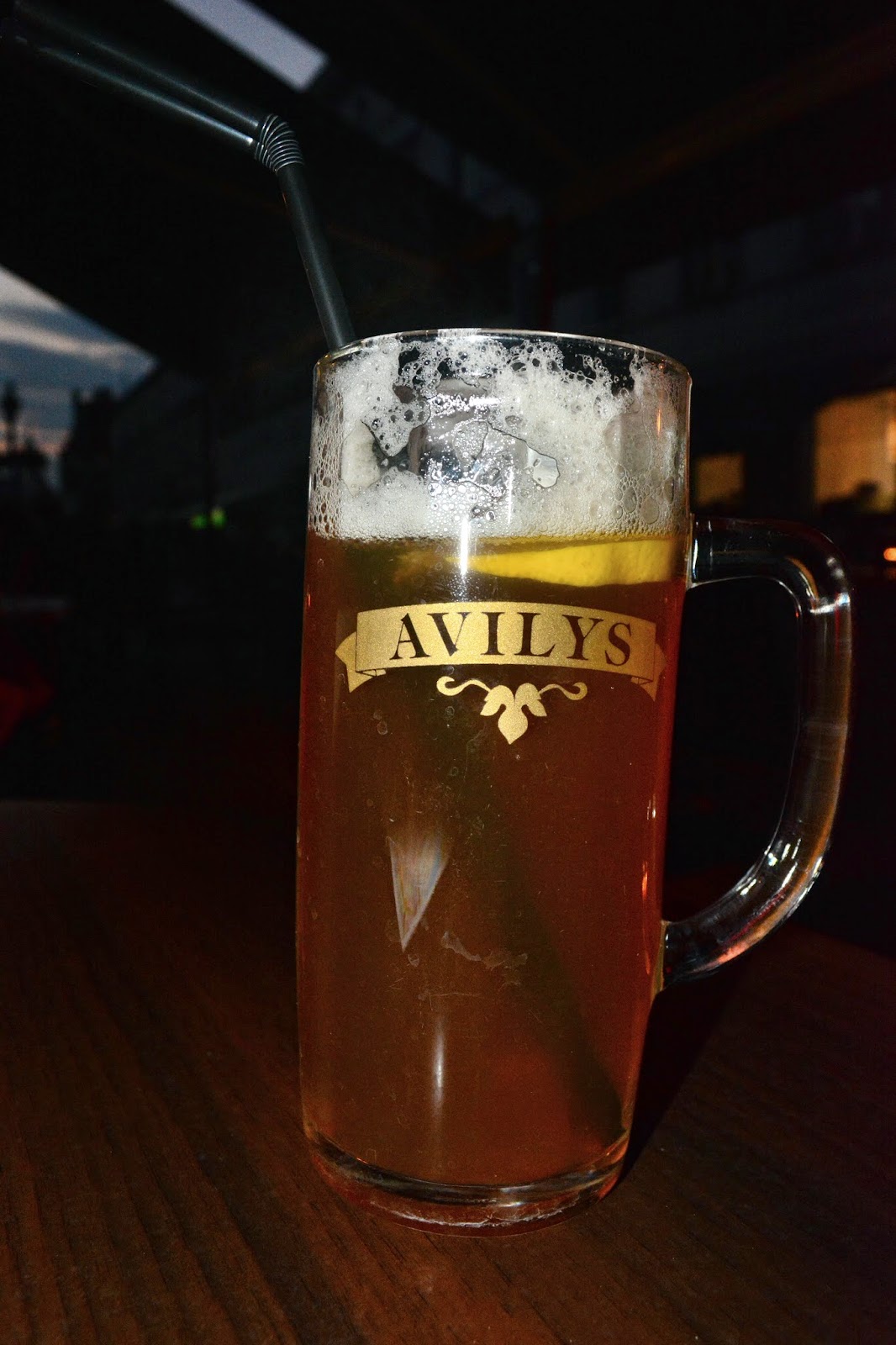
Mulled Beer with Straws

Sunday 21st September.
In fairness to the Ibis, they do a fairly good breakfast.  My plan  is to go up one of the two funicular railways  in the city and I get the No 3 bus which seems to go in the right direction according to the bus map. Eventually I realise that we are have gone too far out of the city so I get a tour of the Northern suburbs.  Lots of 4 -6 storey apartment blocks but much lower density than Singapore. Not surprising since Lithuania has just over half Singapore's population spread over an area nearly 100 times greater. Lots of green space, a few local shopping centres, also quite a lot of individual houses in some areas. It all looks a lot better than I expected although admittedly it is a sunny day! The bus route seems to have been designed by someone throwing some tangled string onto a map, meandering in all directions then crossing the river and dumping me at an out of town hospital complex. According to the timetable at the bus stop, the No 11 bus should take me back into the city and there is one due in a few minutes, but it doesn't show up and since this is the terminus, makes me go and look at the timetable again.  Come to the conclusion that it doesn't run on Sundays, so need two buses to get to the centre. 


Traditional Wooden House just outside the City Centre
Since the "Kaunas in your Pocket" guide  lists the castle as somewhere to visit I follow the map to find it, only to realise it is where I was yesterday. I wonder whether I missed something but come to the conclusion I didn't, even after climbing up a few steps to get a better view.

Kaunas Castle. That's all there is

Wise Old Man. Mural on Wall near Castle
Back in the main street, realise that there are two old style minis, beautifully restored. One is advertising the Republic Bar so I am quite surprised to see someone get into it and drive it away.

One of the Two Minis in Vilnaus Street
Also visit the St Peter and St Paul cathedral on the advice of the guide. From the outside it is an unexciting, squat, red brick building but inside it is yet another ornate baroque cathedral.
Yet more Baroque Extravaganza
Time to sit down for a snack of cheese and ham crepes and a glass of win and watch the world go by.

In the evening, go out to one of the restaurants suggested by the guide, Bajorkiemis City, which is a new building just outside the Old City. The design is rather strange, along one side of the restaurant the decor is very traditional, lampshades with tassels etc, while on the other side the style is very modernistic. I have the cold beetroot soup which is good but overpoweringly pink! I thought  Singapore Slings were the pinkest substance that could be eaten or drunk but the beetroot soup is pinker!

Monday 22nd September

Have another wander round the old city, which is much quieter than over the weekend. The pavement cafes are almost deserted so it looks like a lot of their patrons are local or weekend visitors. Near the river I come across  a modern grey building,  the "Jezuito Gimnazija", literally "Jesuit Gymnasium", which conjures up visions of young priests in cassocks climbing up ropes and swinging from the wall bars. Inside the grounds, I am astonished to see three very attractive girls, probably in their late teens,  all with blond hair, chatting among themselves and I wonder whether they have been planted by the authorities to test the  resolve of the young priests. But the reality turns out to be more prosaic; it is a high school founded by a Jesuit in 1649.

Wednesday, 24 September 2014

Vilnius to Kaunas (104 km, 65 minutes) Short Journey, Short Blog

Saturday 20th September

First grey day for a long time. My train is due to leave Vilnius station at 1225 from Track 4. Here the tracks are in sequence but to confuse the foreigners they have both track and platform numbers. The train is a bright, red and grey, new double decker which leaves quietly, smoothly and on time. Soon we are out in the countryside. A yellow LED display shows the next station in Lithuanian and English;. all very civilised. Opposite me is  a Frenchman who has found a fellow French  speaker,  or maybe just a passive listener, because although he is engaging him in conversation it sounds very one sided and I suspect my fellow traveller would prefer to be left in peace. Outside I can see yet more forest! The combination of forest scenery and a French monologue send me to sleep. We have only one brief stop and then we are in Kaunas. The shortest journey of my trip. Just over an hour. Not far from the station to the Ibis where I am staying. It looks very new, with clean minimalist design.


Vilnius Station

Nice  New Train

Nice  New Train
Kaunas Station


Ibis Hotel, Kaunas